The Elves
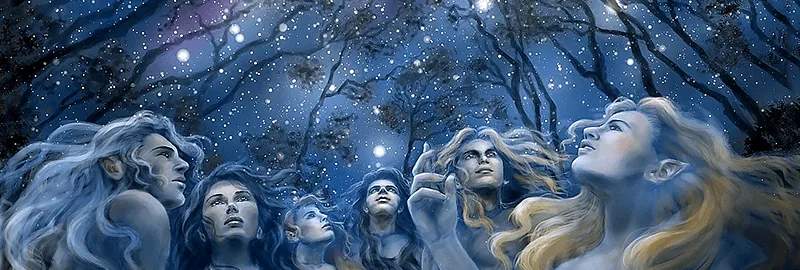
The Elves, or Firstborn, were the first of Eru’s Children to awaken. Born under the stars before the ascension of the Moon and the Sun, they retain a special love for light and an inner spirit endowed with unique gifts. They call themselves the Quendi, or “Speakers,” for they were the first to utter words; and, even now, no race understands language and song like the Firstborn. Fair and fine featured, brilliant and proud, immortal and strong, tall and agile, they are the most blessed of the Free Peoples. Yet, despite their gifts, they a cursed race — one burdened by the Hand of Fate.
An Overview of Elves
Like the other Free Peoples, such as Men and Dwarves, the Elves have many branches and many figures of note. Their tale is one of long migrations, prideful wars, and grand achievements. It includes many players.
Elven History
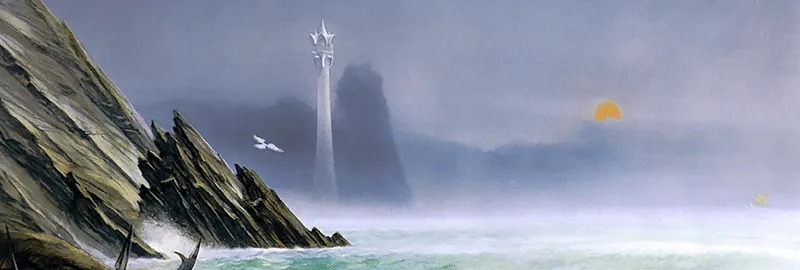
The divisions and sub-divisions of the various Elven kindreds are complex, and at times even convoluted. In this section the basic migrations and divisions will be described, as well as the actual kindreds as they existed in the Second and Third Ages of Middle-earth.
The Awakening of the Firstborn
In the early years of the world, before the Sun and the Moon first rose, the Elves, the “First-born”, awoke under the stars on the shores of Cuiviénen, a large bay in the inland sea of Helcar in eastern Middle-earth. They lived in the twilight world, far from the light of Valinor, for many years before one of the Valar — Oromë the Huntsman — discovered them. The Valar loved Eru’s newborn creations and wished to bring them to the light of Aman, the Undying Lands to save them from Morgoth and the evil that he was already bringing into Middle-earth. Morgoth, the greatest of the Valar who had turned away from his brethren before the beginning of creation, now hated the Elves because they were cherished by the others. He sent out his shadowy servants and captured many of them in the darkness. Unable to create life himself, he tortured and perverted the Elves he imprisoned, and from this corrupt stock bred Orcs.
The First Sundering
It was at the summons of the Valar that the Elves first divided. At first, the Elves were afraid to leave their home under the stars, but three of their kind journeyed to Valinor with Oromë to see for themselves the glory of the Undying Lands. These were Ingwë, Finwë, and Elwë, who later became kings. When they returned, filled with the light of Aman, many of the Elves heeded their stirring words and followed the Valar west.
But not all the Elves wished to leave their native land. Some had come to love the starlight of Middle-earth and chose to stay behind. Those Elves who declined to follow the Valar became known as the Avari (“Unwilling”), and they became the lesser Silvan Elves. They were by far the most plentiful of the Elves, and, despite harassment by the Black Enemy, spread through eastern as well as much of western Middle-earth.
Those who followed the summons of the Valar and undertook the Great Journey westward to Aman became known as the Eldar. And yet, still some lingered along the road or turned back, or were lost. But those Elves who completed the long and difficult journey were made greater by their stay in the Undying Lands, and forever after their descendants held that pure light in their eyes.
The Great Journey of the Eldar
The Eldar were those who made the great journey to live in the Blessed land of Aman. There were three Kindreds: the Vanyar, Noldor and Teleri. The Eldar came to the Uttermost West via an unusual mode of transportation: The Island Tol Eressëa, which, moved by the power of the sea-Vala Ulmo, made two trips from Middle-earth to the Undying Lands. The first trip carried the Vanyar and Noldor; the second carried the Teleri (“hindmost”) who had lingered on the long road and missed the first island voyage.
The Teleri were also divided, however. There were three groups, led by the brothers Olwë and Elwë, and another Teleri, Lenwë. When they reached the vales of Anduin, Lenwë and his people turned away from the journey and remained in Middle-earth. They became the Nandor and vanished for many years. Also, on the trip Elwë (who had been an original ambassador to the Undying Lands) met Melian the Maia and fell into a trance of love. While he was lost, most of his group went over the sea on the isle with Olwë’s people. Elwë at last awoke, and eventually set up a realm in Beleriand with his Maïar wife Melian. As ruler of this land, he went by the name Elu Thingol (King Greycloak). The rest of the Teleri, however, went westward, living on the isle of Tol Eressëa, in sight of Valinor. The Maia Ossë taught them the art of shipbuilding and they were ever after the greatest shipwrights and sailors in all Middle-earth. They sailed to the coast of Aman where they built the beautiful city and wharves of Alqualondë.
The Teleri were also considered the fairest singers in all Middle-earth (rivaling the Vanyar) and called themselves the Lindar. This name related later to one of the titles of the “Golden Wood,” Laurelindórenan.
The Nandor (“Those who turn back”), though technically of the Teleri and so the Eldar, are an exception, since they never traveled to the Undying Lands, and so did not see the light of the Trees. Therefore, they were referred to as Moriquendi (“Dark Elves”). Some eventually went on to settle in Ossiriand, but most remained east of the Misty Mountains, spreading through the forested lands there. These later came under the rulership of the Sindarin King Thranduil in Mirkwood and, of course, Galadriel in Lórien.
The Vanyar’s Settlement
Fairest of the Eldar, and known as the Fair Elves, the Vanyar were the most beloved of the Valar. They were the first of the three kindred to set forth on the Great Journey and the first to arrive in the Undying Lands (Aman), led by their king, Ingwë. Together with the Noldor, they built and lived for a long time in the fair city of Tirion. Sometime later, however, they moved further westward through the gap in the Pelóri (Q. “Mountains of Defense”), and there they made their permanent home.
Only once did the Vanyar ever leave Valinor, and that was to aid the Ainur in battle against the Black Enemy. When the evil Vala was at last defeated, the Fair Elves marched back to their home in victory. There is no record of a Vanya ever again leaving the Blessed Land of Aman.
The Noldor’s Settlement
The Second Kindred of the Calaquendi, both in size and in order of arrival in Aman, the Noldor were also called the Deep Elves. Finwë was their king. They were the most skilled in crafts and lore of the Immortals, the most fiery of spirit, proud and curious. It was Fëanor the Noldo who made the Silmarils, and because of his unwillingness to surrender them, doomed his kindred to a hopeless war against Morgoth to recover the stolen gems, and later to exile from Aman. When the Black Enemy made away with the Silmarils and fled with them to Endor, the Noldor attempted to pursue him over the water by stealing the great boats of the Teleri. The Teleri resisted, and the Noldor, in their desperation, slew a great many of the defending shipbuilders to win the boats. But great was the anger of the Valar that Elf would slay Elf. A storm swallowed many of those stolen boats and the surviving Noldor landed on the shores of Endor only to be met by one of the Valar who doomed them to exile from Aman forever for their hideous crime, the Kinslaying. The Noldor had seen the light of the two trees, but lived out their days in Middle-earth as exiles.
It is perhaps doubly sad and ironic that Fëanor’s grandson Celebrimbor was seduced by Morgoth’s servant Sauron even as Fëanor was corrupted by the evil Vala’s deceptive words. Twice did the Noldor put all of Middle-earth in peril because of their insatiable desire for knowledge.
The Sindar and the Second Sundering
The original Sindar are believed to be those Teleri who waited for their leader Elwë (Thingol), and the Nandor who traveled as far west as Beleriand. The two groups mixed together and became the Sindar, and although they were perhaps more noble than the original Avari (“The Unwilling”), the Sindar were still Moriquendi, for they never reached the shores of Aman. Their homeland was the realm of Doriath in Beleriand, ruled by Thingol and Melian. Although merely Moriquendi, the Sindar gained great wisdom under the tutelage of Melian the Maia and her husband, who was Calaquendi, having once been to Valinor, and so they became known as the Grey Elves. The Sindar spoke Sindarin, and originated the written script Cirth. With the fall of Beleriand, the surviving Sindar migrated eastward, some remaining in Lindon, while others traveled to live with the Noldor in Eregion, or, east of the Misty Mountains, in Lórien and Mirkwood.
Elven Nature
Before going into the details of Elven physiology, it is perhaps worthwhile to comment on the sociology of this powerful race and how they are sometimes erroneously perceived.
Though the mists of time may eventually blur understanding of the nature of the Firstborn, it remains clear during this period that they were not simply a collection of ethereal beings who lived in utopian societies where there were no laws, no social structures or other such mundane organizational boundaries. Indeed, it seems that only the Silvan Elves (and to a lesser extent, a number of the Moriquendi Teleri) even desired this sort of existence, who in fact generally lived in realms ruled by Sindar or Eldar kings, as was typical of Elven hierarchies. The Sindar lived in kingdoms as well, but it was the Noldor more than any other kindred who sought order and design in all facets of their lives. They had governments (usually monarchies) and frequently elaborate guilds and brotherhoods. Families tended to rule not only realms but the guilds within them in a dynastic fashion.
Familial and Geographic Divisions
There were two different hierarchies among the Elven peoples: that of geographical location, and that of family or kindred. The accompanying chart should help to clarify the distinctions of the divisions.
The Calaquendi (“Light Elves”) traveled to the Undying Lands and saw the Light of Aman, the light of the Two Trees. This classification includes all descendants, for the Light permeated the very being of the Firstborn and left with them an internal light which they carried with them forever. Sometimes, a visible aura shone about a Light Elf.
The Moriquendi (“Dark Elves”) never made the journey to Aman, or stopped along the way, failing to achieve their destination. There is also a third division, the Sindar (“Grey Ones”), who traveled as far as the western shores of Middle-earth and stopped there. However, they lived in Doriath under King Thingol (Elwë) and the Maia Melian. Thus, they achieved greater wisdom and understanding than the Moriquendi, yet did not personally witness the Light as did the Calaquendi. They were in between; the Elves of twilight.
Paralleling this geographic distinction is that of race. All of the Vanyar, Noldor and Teleri were considered the Eldar (“People of the Stars”) even though some Teleri groups did not complete the journey (specifically the Sindar and Nandor). Those Elves who were not Eldar were, by definition, Silvan.
Language
When the First-born awoke on the shores of Cuiviénen, with them awoke language in Middle-earth. It is the Elves—or, appropriately, the Quendi (“Speakers”) as they called themselves—who taught all other races and creatures’ language, each after its fashion. When the Eldar went West, however, they encountered the Valinorian Tongue of Aman, and adopted it for their own. Indeed, this may have occurred as early as the return of Ingwë, Elwë and Finwë from Aman with Oromë the Vala. This became the pure tongue Quenya. The many Silvan tribes still in Middle-earth, though influenced by Quenya initially, diverged and changed with the flows of the world, and the original Elven speech became fractured and rusticated by myriad dialects. By the Second and Third Ages, The Silvan and Eldarin tongues had become so divergent that the two had no common ground. When Silvan Elves lived with Sindar or Noldor, they invariably learned Sindarin and used it except when exclusively among their own kind. The Silvan Elves of Lórien, for example, spoke Sindarin, but with an accent, harkening to their Greenwood Silvan origins.
The Sindar knew Quenya, but adapted it for their own use, creating a language less formal and more practical for everyday writing and conversation, a language that became known as Sindarin. Thingol, their king, banned the use of Quenya among his people after the Kinslaying, and with the passing of the years, even the Noldor came to use Sindarin as their common tongue, reserving Quenya as a formal, ritualistic language.
The Tengwar were the first written letters ever devised, invented by the Noldorin poet Rumil of Tirion. The pure version of the Tengwar was known and used only in the Undying Lands. Fëanor later adapted and revised this alphabet, and the Fëanorean Tengwar attained much more widespread use, both in the Undying Lands and in Middle-earth. Both of these written alphabets were cursive, meaning that they were designed to be joined, written in flowing strokes as with a pen. They were somewhat impractical for engraving, but the Great Smiths in Eregion—and Sauron himself—were up to the task. Sauron’s inscription inside the One Ring was engraved in cursive Tengwar.
Much later the Sindarin Bard Daeron invented the runes called the Certhas Daeron (“Cirth” or “Letters” of Daeron). These were much more angular and suited to stonework. The Dwarves of Moria particularly loved this writing style and adopted it as their own.
Religion
Religion in any organized sense was unknown to the Elves, especially the Eldar, who knew the Valar more as esteemed and revered teachers than actual deities. Virtually all Elves worshiped Eru Ilúvatar (“The One”) as the creator of all things: the earth, the Valar, Elves and Men. (Dwarves, created by Aulë, are thought of differently.) In this way, they saw themselves on equal, though perhaps different, standing with all other beings. Worship of Eru was very informal, however, involving no specific temple or other structure more elaborate than an open garden. The Elves worshiped Eru for the beauty of his creation. They celebrated the light of the stars or the sound of falling water, the sweetness of fruit or the luminescence of gems from deep within the earth. With song they rejoiced in the magnificence of Eä, for music was the Essence of Arda.
This is not to say that the Elven societies were devoid of ritual. In a world where oaths were not empty promises but calls to the Valar themselves, ritual played an important role. With song and chant the Elves wielded the Essence, weaving spells of great power and subtlety. Within the guilds and other groups, there was a great deal of ceremony, and among the Noldor social formalities were often observed with an impassioned zeal.
Elven communities, like any community, required economic support; again, they were not idyllic communities where there was no need for work. Elves gardened, mined, built, cooked, and generally labored even as did mortals in their society. It is true, though, that the Elves had different mental capabilities, and even the most odious labor did not weigh on them at all. Perhaps it was because of their ability to “walk as if in a waking dream” which gave them a reputation of being free of care and responsibility.
Physical Characteristics
Although basically similar in appearance to mortal men in many ways, Elves had several important, if subtle, differences.
As a race, they were taller than most humans (save the high Edain) though in general tended to be less heavy of build. The males generally ranged in height from 6′ to 6′10″, and in weight from 160 to 250 pounds, respectively. The women of the Elves were usually between 5′6″ and 6′2″, and were also slim. Although to some this race might have appeared fragile, Elves were generally just as strong as any human warrior. The Eldarin Lords, in fact, were muscular of build and unquestionably the most physically powerful individuals in Middle-earth.
Elves had less body hair than humans, and Elven men had no facial hair, as a rule. Highly resistant to extremes of natural heat and cold, their clothing was worn for decoration, camouflage, or, perhaps, modesty. With their fine features and unmarred, perfect skin, Elves were invariably more handsome in appearance than their mortal brethren.
Their senses were extremely keen, especially sight and hearing. Elves were able to see on a clear starlit night as well as if it were full daylight. In what a man would have called “pitch blackness,” an Elf could still see a few feet. Some of the Elves, the Eldar, could hear into each other’s minds, without the necessity of speech, and all Elves could hear sounds that humans could not.
Elves did not need sleep to rest their bodies as did Men and Dwarves; instead, for a few hours each night, they entered a sort of trance, a waking dream during which they meditated upon the beauty of Eä or in which they recalled happy times earlier in their long lives. Gimli the Dwarf made this observation as the Fellowship left Lórien.
“…Elves may see things otherwise. Indeed, I have heard that for them memory is more like to the waking world than to a dream. Not so for Dwarves.”
(LotRI 490).
Perhaps most remarkable was the fact that Elves did not age or grow old, and their bodies were immune to all disease and infection. They were virtually immortal unless slain in battle. Should an Elf be killed, his soul was transported to the Halls of Mandos in Valinor where, after a period of waiting his body was reincarnated and he was free to live in the Undying Lands—though forbidden to return to Middle-earth until the end of the world.
Elves healed quickly and they showed no scars, although they could not regenerate severely damaged organs or body parts. Their bodies matured through a slightly longer adolescence than mortals, and at full maturity the aging process stopped. Only in the depths of their eyes could one perhaps feel a glimmering of the true age of the greater Elves, and only those Elves upon whom the weight of Middle-earth lay heavy. The lesser kindred, even after thousands of years, looked like beautiful, carefree youths.
The most subtle of all the characteristics of the Elves was the aura that bathed each of the Calaquendi. Those who had seen the light of the Two Trees in Aman carried with them a reflection of that splendor, like an afterglow of that first illumination, now forever darkened through the evil of Morgoth. This aura was not necessarily obvious, but the lesser beings of Middle-earth could sense it, a shimmer dancing on the edge of their vision.
Elven Sub-Groups
The Vanyar
The Vanyar had golden hair and fair skin, with eyes of clear blue or violet. They were the tallest and most beautiful of the Elves, beloved of the Valar. Ingwë was their king, and as such he was King of all the Elves. Their musical skills were unsurpassed, except perhaps by the Lindar (Teleri) who learned the art of song from the Maia Ossë. The Vanyar spoke pure Quenya, the original tongue of the Eldar, which was in fact the Elvish version of Valinorean, the mental language of the Valar.
The Noldor
In appearance the Noldor had hair of dark brown to raven-black, fair skin, and dark brown or grey eyes—with one exception: the children of Finwë, King of the Noldor, and Indis of the Vanyar. Their sons, Fingolfin and Finarfin, both had hair of gold like their mother, and the trait was passed to their offspring as well. This included, of course, Galadriel, the daughter of Finarfin.
The Noldor were a noble and courageous race, who behaved with dignity and heroism, even under their Doom. Most of these kindred were of substantial build. Some of the greatest warriors of the First Age were Noldor Lords, some of whom were able to hold their own in single combat with a Valaraukar (Balrog), a great demon of Morgoth. Fingolfin, son of Finwë and Indis, was accounted the greatest warrior in all of Endor, surpassing all the other Elves and Men.
Another one of the great Noldor warriors was Glorfindel, of the house of Finarfin, who lived in Elrond’s House in the Third Age. Below is an excerpt from LotR where Gandalf, in Rivendell, is explaining to Frodo what happened at the Ford when the Hobbit briefly put on the One Ring, and Glorfindel stood against the Riders:
“…those who have dwelt in the Blessed Realm live at once in both worlds, and against both the Seen and Unseen they have great power.”
“I thought that I saw a white figure that shone and did not grow dim like the others. Was that Glorfindel then?”
“Yes, you saw him for a moment as he is upon the other side: one of the mighty of the First-born. He is an Elf-lord of a house of princes.” (LotRI)
The Noldor spoke Quenya amongst themselves and with the Vanyar in Aman, but the vast majority in Middle-earth adopted Sindarin as their everyday tongue, preserving Quenya as much as possible as a ritual language for specific occasions. Most were also able to communicate in most of the western Silvan dialects.
The Teleri
The third group of the Calaquendi had sandy, blond or light brown hair and grey or hazel eyes. In general, they were more of a mix of types than the Noldor or Vanyar. They were also, of course, larger kindred, with greater opportunity for diversity. The true Calaquendi Teleri, who lived on Eressëa, tended to be taller and stronger, with the distinctive High-Elven bearing and aura.
The Sindar and Nandor
Less tall and lordly than the Eldarin kindred, these Elves were nevertheless more noble than the Avari. All tended to be slender, possessing a wiry strength and great agility. Physically they resembled the Teleri, being an offshoot of that group, though they lacked the aura of the Calaquendi, having not seen the Light of Aman. Most, because of their preference for spending extended periods of time outdoors, had darker, lightly tanned skin. Not surprisingly, this group spoke Sindarin almost exclusively.
The Avari Moriquendi
These were the Silvan Elves, most rustic of the Kindred, and most plentiful. They were similar in appearance to the Sindar groups, but slightly lesser in stature, with darker hair (generally chestnut to dark brown) and eyes. Spread throughout Middle-earth, they spoke their own tongues amongst themselves, but when living with the higher kindred invariably adopted Sindarin. The Silvan Elves were also known as the Wood-Elves, for they lived in the woods, forests, and mountains of Middle-earth.
The Classification of Elven Groups
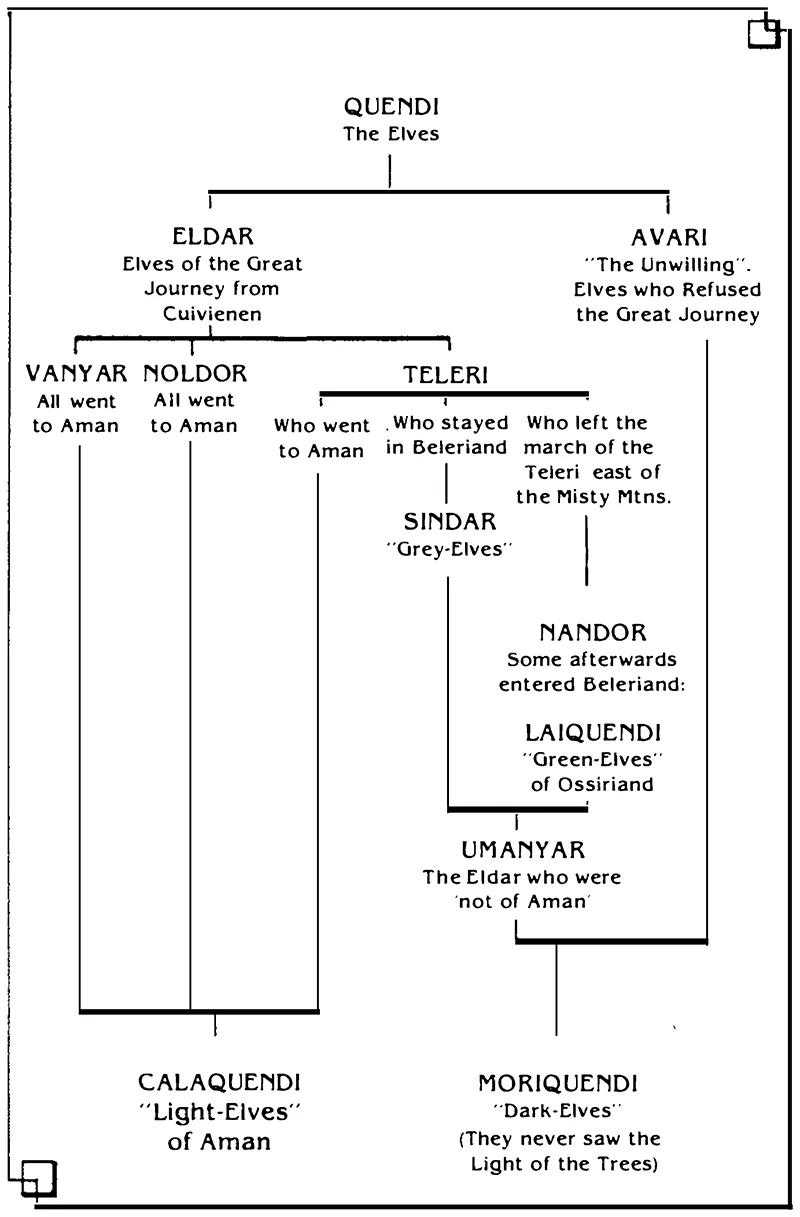
There are two ways to classify the noble Quendi, for their history states that they were twice sundered. The first separation of their people produced the Eldar and Avari: the “People of the Stars” who made the Great Journey toward the Light of Aman, and the “Refusers” who remained in the East of Middle-earth. From the Avari, came the Silvan Elves of lore, who constitute most of Middle-earth’s Elven peoples. The Eldar produced the three great kindreds of the Vanyar, Noldor, and Teleri, many of whom now reside in the Undy¬ing Lands.
It was the Eldar who produced the second sundering. Dividing before they left the shores of Middle-earth, the Teleri produced three sub-groups that never emigrated to Aman and never saw the enchanted light of the Valar’s Blessed Realm. They, like the Avari, are called Moriquendi, “Dark Elves” Their brothers who went west into Aman are called the Calaquendi, or “Light Elves”.
The Calaquendi includes the Vanyar, Noldor, and Teleri of the Undying Lands — together with the Noldor who returned to Endor — while the Sindar and Avari of Middle-earth are counted as Moriquendi. Thus, as noted, there are two ways to classify the Quendi: (1) the Avari versus the Eldar; and (2) the Moriquendi versus the Calaquendi. The follow¬ing tree illustrates their relationship: